

Singapore Runners: Use BMI 23.0 Cutoff to Guide 30–60 g/hr Fueling
A BMI calculator built on Asian and Singapore cut-offs is a solid screening tool for runners, but it was never designed to be a finish-line number. Calculate it in kilograms and meters, compare your result to the local 23.0 overweight and 27.5 obese thresholds, and then let that number point you toward the right fueling and training adjustments covered below. Treat the score as a starting signal, not a target to chase.
TL;DR:
- Maintaining a BMI below 23.0 helps reduce cardiometabolic risk, but muscle mass can cause athletes to register higher without indicating excess fat.
- Long-distance runners typically have a BMI around 19.6, while sprinters average closer to 23.3, reflecting their different physiques and training demands.
- For runs over 90 minutes, consuming 30 to 60 grams of carbs per hour from gels or sports drinks optimizes energy and prevents mid-run fatigue.
- A modest calorie deficit of 200 to 300 kcal daily during the off-season supports weight goals without impairing performance or recovery.
- Combining BMI with waist circumference or body-fat measurements provides a more complete health and fitness assessment for runners.
Table of Contents
- How to Calculate BMI and the Singapore/Asian Cut-Offs You Must Use
- What BMI Means for Different Runners
- Running Nutrition Tied to Your BMI and Training Load
- Turning Your BMI Result Into a Training and Nutrition Plan
- How Racepack Products Match Your Nutrition Plan
- Why Chasing a Number Misses the Point
- Build Your Fueling Kit Around Your Training Plan
- Sources
- FAQ
How to Calculate BMI and the Singapore/Asian Cut-Offs You Must Use
BMI comes from one formula: weight in kilograms divided by height in meters, squared. A runner weighing 65 kg at 1.70 m works out to 65 ÷ (1.70 × 1.70), or roughly 22.5. Always measure your weight in kilograms, since the formula breaks down if you mix pounds and inches without converting first.
Singapore and much of Asia use tighter bands than the World Health Organization’s global standard, because Asian populations tend to carry more visceral fat and face higher cardiometabolic risk at the same BMI as Western populations. The Asian-specific cut-offs run like this:
- Underweight: below 18.5
- Healthy range: 18.5 to 22.9
- Overweight: 23.0 to 27.4 (versus 25.0 under WHO standards)
- Obese: 27.5 and above (versus 30.0 under WHO standards)
BMI alone can’t tell muscle from fat, so pair it with waist circumference (Singapore’s public health guidance flags risk above 90 cm for men and 80 cm for women) or a body-fat percentage reading for a fuller picture.
What BMI Means for Different Runners
There’s no single “ideal” BMI for every runner. Distance changes everything. Athlete data covering marathoners and sprinters puts marathon runners at a mean BMI near 19.6 (± 1.3), while sprinters average closer to 23.3 (± 1.7). That gap reflects real physiology: distance runners carry less muscle mass relative to height, while sprinters need explosive power that comes with heavier, denser muscle.
This is where BMI starts to mislead people who train hard. A muscular trail runner or a track athlete doing heavy strength work can post a BMI in the “overweight” band while carrying low body fat and excellent fitness. BMI can’t see the difference between a kilogram of muscle and a kilogram of fat, which is exactly why sports-medicine teams lean on body-fat percentage or DEXA scans for anyone training seriously.
- Marathoners and long-distance athletes tend to sit lower on the BMI scale.
- Sprinters and power-based runners often sit higher, without extra fat.
- Strength-trained runners may read “overweight” on paper while performing at their peak.
Pro Tip: Track your BMI as a monthly trend, not a daily number. A single post-long-run weigh-in swings with hydration and glycogen stores, not real body composition change.
The practical rule: aim for your lowest sustainable weight rather than the lowest possible number. Chasing a target BMI at the cost of energy, strength, or recovery almost always backfires on race day.
Running Nutrition Tied to Your BMI and Training Load
Fueling for running doesn’t change dramatically by BMI band, but emphasis does. Runners on the higher end of their healthy range, or above it, generally benefit from a gradual, off-season caloric deficit that protects joints and training quality rather than an aggressive cut. Runners near or below the underweight threshold should prioritize eating enough, full stop, since chronic under-fueling raises the risk of Relative Energy Deficiency in Sport (REDs).
In practice: for any run longer than 90 minutes, Johns Hopkins recommends 30 to 60 grams of carbohydrate per hour, drawn from easily digestible sources like gels, sports drinks, or fruit.
Here’s how to apply that during a long run:
- Set your hourly target. Most runners land comfortably at 30 to 60 g of carbs per hour once the run passes 90 minutes.
- Pick a simple source. A single GU Energy Gel 24 Gels pack delivers roughly 20 to 30 grams of carbs per gel, so one gel every 30 to 45 minutes keeps you in range.
- Layer in hydration. A sports drink or electrolyte tab adds carbs and sodium together, useful in Singapore’s heat and humidity where sweat losses run high.
- Recover within the window. Eat a carbohydrate-plus-protein snack within 30 to 60 minutes of finishing, at roughly a 3:1 or 4:1 carb-to-protein ratio, to kickstart glycogen replenishment.
Avoid heavy, high-fat meals in the two to three hours before a long run. Simple carbs before and during exercise, as Mayo Clinic Health System notes, digest faster and cause fewer gut issues mid-run. If you want a deeper breakdown of glycogen timing, the role of glycogen in running covers exactly why the 30 to 60 minute recovery window matters so much.
Turning Your BMI Result Into a Training and Nutrition Plan
Start by naming your actual goal. Are you chasing performance, or trying to shift weight? The answer changes everything that follows. If your BMI sits comfortably in the healthy Singapore range (18.5 to 22.9), your focus should stay on fueling adequacy and training quality, not weight change at all.
If you’re above 23.0 and want to trim weight, do it in the off-season, not mid-training block, and keep the deficit modest, around 200 to 300 kcal per day, so you don’t sabotage recovery or speed work. This kind of gradual approach protects performance far better than crash dieting. A structured training plan that separates base, build, peak, and taper phases makes it much easier to time these small adjustments without wrecking a hard training block.
- Below 18.5: prioritize calorie adequacy before anything else.
- 18.5 to 22.9: maintain and focus on fueling, not restriction.
- 23.0 and above: consider a slow, off-season-only deficit.
Pro Tip: Never attempt a deficit during peak training weeks or race taper. That’s exactly when your body needs full fuel to absorb the training load.
Certain groups need a professional in the loop before making any changes: adolescents still growing, anyone with a history of disordered eating, and pregnant or postpartum runners. A sports dietitian or physician should guide those cases directly.
How Racepack Products Match Your Nutrition Plan
Once you know your fueling targets, matching them to real products gets simple. For runs over 90 minutes, GU Energy Gel – Chocolate Outrage Caffeinated gives a caffeine boost for the back half of a long run, while GU Energy Gel – Campfire Smores Non-Caffeinated suits earlier miles or evening sessions where caffeine isn’t wanted.
- In-run carbs: GU gels deliver 20 to 30+ grams of fast carbohydrate per serving, easy to stack toward your hourly target.
- Hydration: GU Hydration Drink Tabs and Skratch Labs Unsweetened Hydration Sport Drink Mix replace electrolytes lost to Singapore’s heat without extra sugar if you don’t need it.
- Recovery: SiS REGO Rapid Recovery Protein Powder and SiS Beta Fuel Recovery Powder combine carbs and protein for that critical post-run window.
Orders come with next-day delivery across Singapore and product authenticity assurance, so what you plan on paper actually shows up in your fridge before your next long run.
Why Chasing a Number Misses the Point
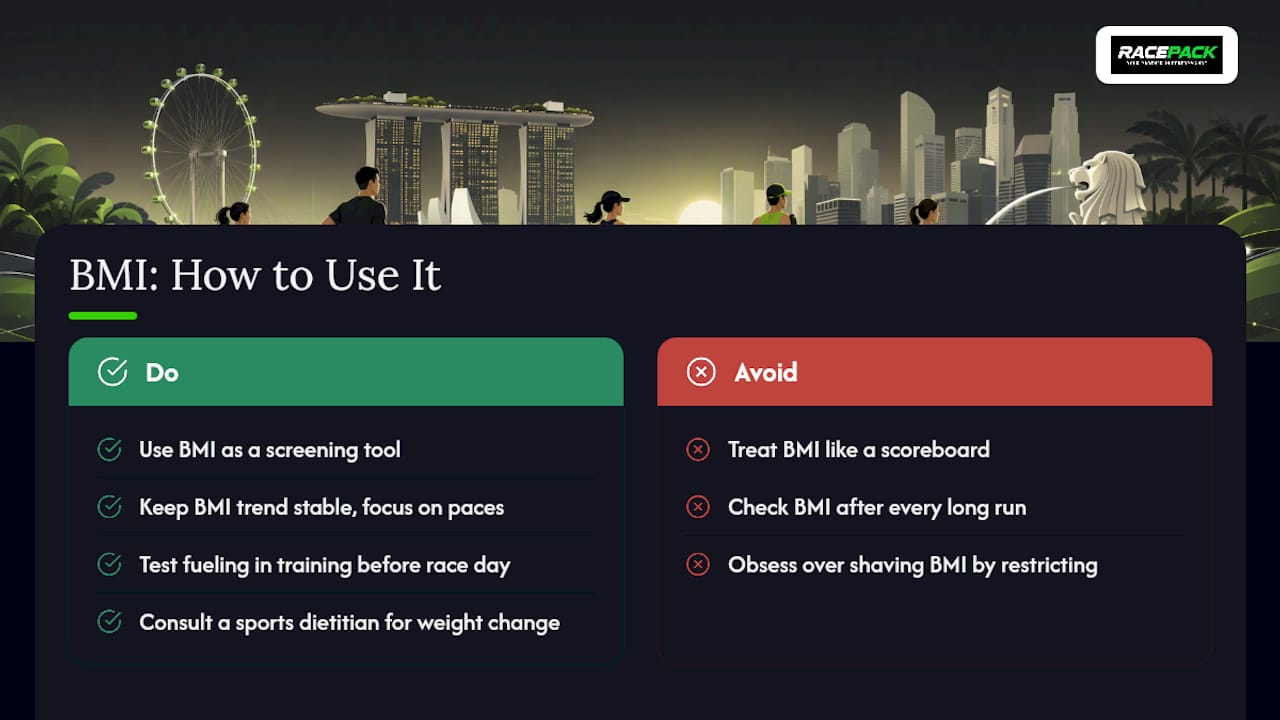
The biggest mistake runners make with BMI is treating it like a scoreboard. It isn’t. BMI is a screening tool, useful for flagging risk trends over months, not a performance metric you should check after every long run. I’d rather see a runner hold a stable BMI trend and strong training paces than obsess over shaving off half a point through restriction.
Test your fueling strategy in training long before race day, and if you’re making real weight changes, loop in a sports dietitian who can look at your full picture, not just one number.
— Jason John
Build Your Fueling Kit Around Your Training Plan
Once you know your carb targets and recovery window, the products practically pick themselves. Racepack SG’s advantage isn’t complicated: guaranteed-authentic stock from GU, SiS, and Skratch Labs, with next-day delivery across Singapore so your fueling plan doesn’t stall waiting on shipping.

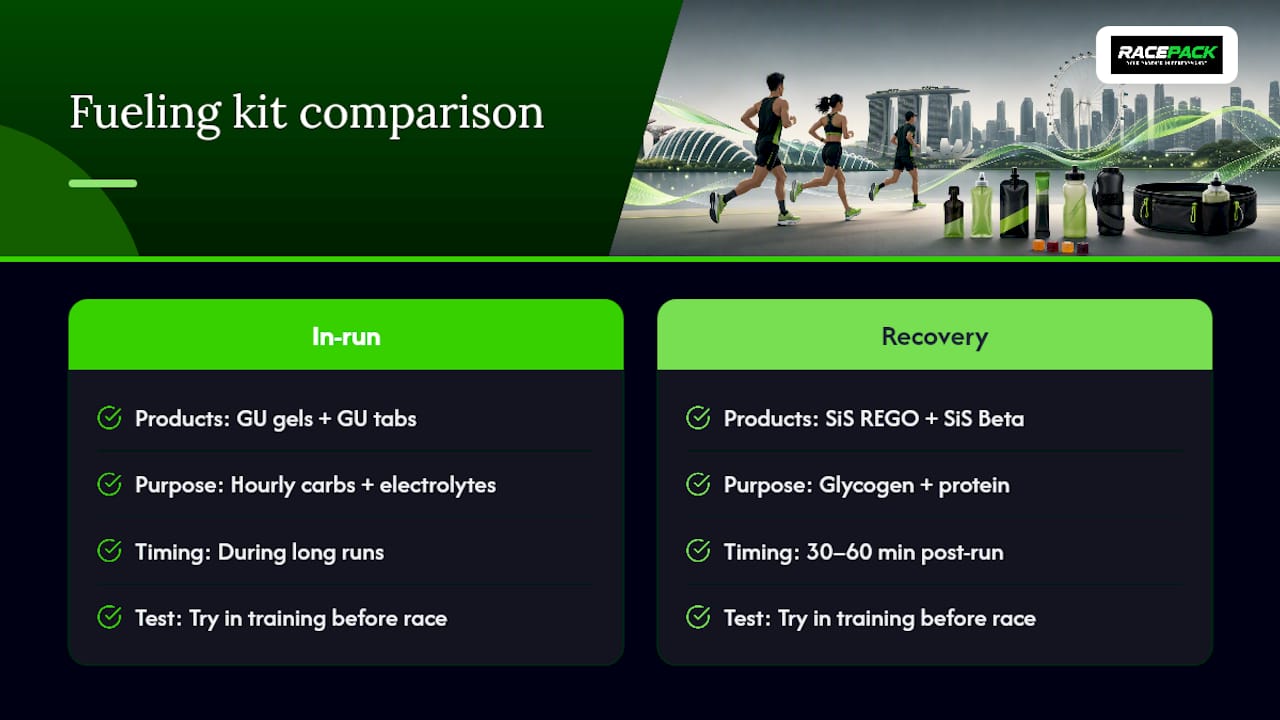
For long runs, an in-run fueling bundle pairing GU Energy Gel 24 Gels with GU Hydration Drink Tabs covers both your hourly carb target and your electrolyte needs in Singapore’s heat. For the 30 to 60 minute recovery window, a recovery bundle combining SiS REGO Rapid Recovery Protein Powder with SiS Beta Fuel Recovery Powder restocks glycogen and delivers the protein your muscles need to repair.
Test any new product on a training run before race day, never for the first time on race morning, and choose the format that matches your actual workout length and gut tolerance. Ready to build your kit? Buy Now and get it delivered before your next session.
This article is general information, not a substitute for advice from a qualified doctor. Consult a qualified healthcare professional about your own circumstances before acting on anything here.
Sources
- PMC — Asian BMI cut-offs and cardiometabolic risk
- Johns Hopkins — Runners’ diet and fueling guidance
FAQ
What Is a Healthy BMI for Runners in Singapore?
Singapore’s healthy range is 18.5 to 22.9, stricter than the WHO’s global range, though endurance runners often sit near the lower end of that band or just below it.
Why Does Singapore Use Stricter BMI Categories Than the WHO?
Asians face higher cardiometabolic risk at lower BMI levels than Western populations, so Singapore’s overweight threshold starts at 23.0 instead of the WHO’s 25.0.
How Do I Calculate My BMI Correctly?
Divide your weight in kilograms by your height in meters squared; always measure your weight in kilograms rather than pounds to avoid conversion errors.
Can a High BMI Still Mean I’m Fit as a Runner?
Yes. Muscular or power-focused runners can score “overweight” on BMI while carrying low body fat, which is why body-fat percentage or DEXA scans give a clearer picture for athletes.
How Many Carbs Should I Eat During a Long Run?
For runs over 90 minutes, Johns Hopkins recommends 30 to 60 grams of carbohydrate per hour from sources like gels or sports drinks.
What Should I Eat After a Run to Recover?
Eat a carbohydrate-plus-protein snack within 30 to 60 minutes of finishing, ideally at a 3:1 or 4:1 carb-to-protein ratio, to speed up glycogen replenishment.
Should I Try to Lose Weight if My BMI Is Above 23.0?
Only with a modest, off-season-only caloric deficit of around 200 to 300 kcal per day, and never during peak training or race taper.
Is BMI a Good Predictor of Running Performance?
Not on its own. BMI ignores muscle mass and doesn’t account for discipline differences, since marathoners average a BMI near 19.6 while sprinters average near 23.3.
What Products Does Racepack SG Recommend for Long Runs?
Racepack SG stocks GU Energy Gel 24 Gels for in-run carbs and SiS REGO Rapid Recovery Protein Powder for post-run glycogen and protein replenishment.
How Does Singapore’s Climate Affect My Hydration Needs?
Heat and humidity increase sweat and sodium losses, so runners typically need electrolyte-focused hydration like Skratch Labs Unsweetened Hydration Sport Drink Mix even on runs under 90 minutes.
Does BMI Predict Running Injury Risk?
BMI alone offers limited insight into injury risk since it can’t measure joint loading, muscle imbalance, or training volume, all of which matter more directly.
Where Can I Buy Gels and Recovery Powders for Training?
You can find energy gels and recovery powders directly through Racepack SG’s catalog, with next-day delivery across Singapore.